You’re Not Blocked. You’re in the Wrong Room.
You’re not stuck — you’re in the wrong room: wrong energy, wrong light, wrong air. Change the environment, change the glasses, and the work you couldn’t force starts to move.
The confession
Yes, I know. The guy who's run turnaround businesses for thirty years, built himself a fleet of automation, and flown airplanes across three continents still sits down at the same desk every time and makes his own work worse before he's written a single line about it. Pot, kettle, black. I know.
Here's why, honey badger, and it's not a flaw — it's our wiring. We're doers. We'd rather wrestle the bear than read the map. Action is the thing that got us every win we've ever had; we start the race while everyone else is still stretching. That instinct is a superpower, and I will never tell you to kill it. You should start the race — starting is the whole game most people never play. But every superpower has a shadow, and here's ours: we confuse motion with progress. We tell everyone how busy we are like it's a medal. It isn't.
Busy is not productive. Motion is not progress. Nobody pays you for the laps — they pay you for the finish.— Grayson Wolf
So let's name the real friction. The room you plan in is never neutral. It's either doing the work with you or fighting you the whole way through — in your business and your personal life. Most of us never once look at the room. We blame the project, the focus, the day. We never blame the four walls we chose to sit inside. Two men a lot smarter than me said it across a century:
"Environment is the invisible hand that shapes human behavior."— James Clear
"We shape our buildings; thereafter they shape us."— Winston Churchill
You are not weak. You're just sitting somewhere that votes against you.
When your superpower turns on you
The thing you're best at is the thing you'll overuse until it starts working against you.
"Live by the power of one more — one more call, one more rep, one more round."— Ed Mylett
He's right. That's how winners are made. But one more only pays when it's aimed. One more feature on the wrong product. One more sales call reading the wrong script. One more late night at the same desk that's fought you for three days. One more try at a relationship where the other person checked out a long time ago — more effort never fixes a thing the other side already abandoned. One more isn't always the answer.
"What got you here won't get you there."— Marshall Goldsmith
There are two ways to run from the real work, and both feel productive. One is ours — build before you think, mistake busy for done. The other belongs to the over-planners: the folks who research, collaborate, and now use AI to over-plan every little thing and still ship less than the person with a legal pad and a deadline. More technology, less output. Two ditches, same road. (Does the tech make you more productive or less? Depends entirely how you use it — that's a friction of its own, and I'll take it apart another day.)
The fix isn't to stop starting. The story goes that Herb Kelleher and Rollin King mapped Southwest Airlines on a cocktail napkin — three cities, three lines — and built a giant out of it. That napkin is the whole move.
"A plan on a napkin beats a masterpiece you never start — and it beats starting with no plan at all."— Grayson Wolf · The Napkin Rule
Plan like a sniper, then move like you always do.
The pool, and the desk that costs you by the hour
This week I took one laptop to the pool for an hour. No build. No tools open. No blank timeline, no blank doc, no blank deck daring me to fill it. Just notes — what am I actually trying to make, in what order, with what I already know I'll have forgotten by Thursday. An hour later I had a plan I could hand to anyone, including myself in three days. I walked back to my desk and the thing that had fought me for three days moved in an afternoon. Nothing about me changed in that hour. I didn't get smarter by the pool. I sat somewhere that wasn't screaming at me to produce — and in the quiet, the plan I already had in me finally had room to show up.
Compare that to the version I run far more often: idea hits, I open the laptop at the same desk I've used for six years, and I start building before I've written down what I'm building. It's faster in the first hour and slower every hour after.
Starting feels like progress. Planning feels like a delay. It's the exact opposite.— Grayson Wolf
The desk is wired for one thing: go. Six years of muscle memory say open the screen and move. The cursor blinks like it's waiting on you. Everything in that room rewards motion and punishes thinking — so you give it motion, and you pay for it every hour after the first. A room like that doesn't make you lazy. It makes you premature. It talks you into building the wrong thing fast instead of the right thing calm. A writer types before he knows the point; a designer opens the file before he knows the message; a closer dials before he knows the one line that lands. Same disease, different desk.
The Toothbrush Effect
Let me show you where this goes when it goes right. Sales used to be hard for me. Then, for a long stretch, it got easy — easy enough that I stopped thinking about it, the way you stop thinking about brushing your teeth. What changed wasn't my talent; I finally understood what I was actually doing and why it worked, instead of doing it and hoping. The fog cleared, and the same motions that used to cost me everything started costing me nothing. (I wrote about that cleared-fog state before — I call it Flow.)
That's the bar. It has two parts, both required: it's automatic — you can do it tired, distracted, on your worst day, no pep talk, your hands know the way — and it's explainable. Richard Feynman, one of the sharpest minds of the last century, built a whole learning method on the second half: if you can't teach a thing in plain words, you don't really understand it yet.
"If you can't explain it as simply as brushing your teeth, you don't own it yet — you're just getting lucky on repeat."— Grayson Wolf · The Toothbrush Effect
And you don't reach that bar at the desk screaming at you to produce. You reach it in the room quiet enough to let you see why the thing works. The quiet room isn't where you go soft. It's where mastery gets built.
Two rooms, on purpose
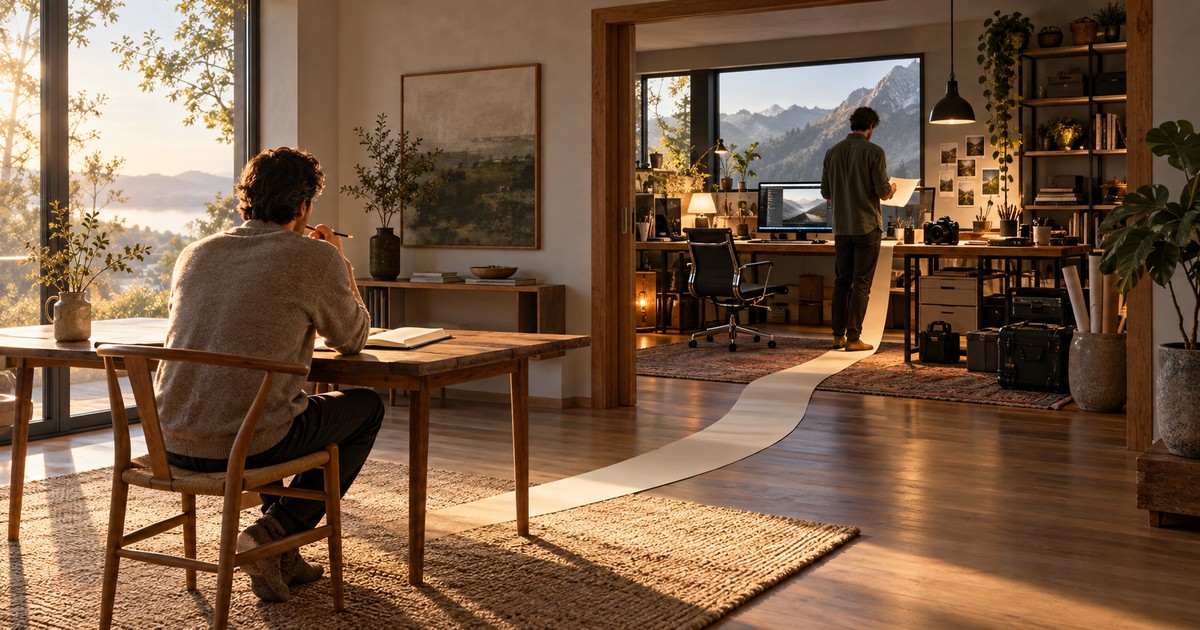
This week I turned my own bedroom into a guitar room. Two iPads, a journal, nothing to do with any work I'm running. That's not a hobby update, butterfly — that's a second environment, built on purpose. You don't need one perfect room; you need two, pulling in opposite directions. One room for building — screens, tools, keyboard, camera, where execution is fast and cheap and nobody's precious about it. One room for nothing but thinking on paper — no screen begging for input, no notifications, no "just ship it" baked into the furniture. Most of us only ever build the first one. We give execution a home and leave thinking homeless, then act shocked when we execute fast on half-baked plans. And this isn't just a work trick — change the room on a hard conversation, a big personal decision, a money problem, and you get the same effect: different room, different you, different answer. The lever works on your whole life, not just your calendar.
Why "too simple" is the lie we all tell ourselves
I didn't invent any of this. People who'd proven it were saying "change your environment, change your output" long before I needed it — Jim Rohn's version is older than I am. I ignored it for years because it sounded too simple to be the real fix. And when I didn't ignore it, I failed it the other ways: I over-planned it into the ground. I kept the plan in notes so disorganized I could never find it, so I never executed it properly. Or I skipped the plan entirely and just started the race blind. Every flavor of getting it wrong, I've run. It is the real fix. Simple and true aren't opposites. I just wanted the solution to feel harder than sitting somewhere else for an hour — because if the fix is that cheap, the three days I burned were on me. That's the real reason sharp people skip the easy answer: the easy answer makes the wasted time their fault.
The move: twenty minutes, by hand, nowhere near it
Before you start your next build — whatever it is — don't open the laptop first. Go somewhere that has nothing to do with the work: a different chair, a different building, a bench outside. And write the plan by hand before you touch a keyboard. Twenty minutes. Nowhere near your desk.
The tool matters here, so hear me: this runs on the simplest thing in the building, not the most powerful one. Pen and paper, or the way I actually do it — an iPad and Apple Notes, no AI in the loop, no build window open. Just an organized place I can write anything down anywhere and pull it back up anywhere: on a plane, in a car, at the pool, with no internet at all. The magic word is organized — a thousand loose notes you can't find is just a prettier chaos. (How I keep that system clean enough to trust is its own friction, another day.)
Then come back and watch the thing that was fighting you stop fighting. Not because you got smarter in twenty minutes — because you finally did the thinking in a room that let you. You already know how to plan. You've just been doing it in the one room guaranteed to talk you out of it. The work was never the problem; the room was. Your action was never the problem either — it's your gift. It just needs twenty quiet minutes of aim before you let it off the leash. So build two rooms: one to make the thing, one to see it clearly first. Think where it's quiet, build where it's loud, and keep your superpower pointed at the right target. Do that enough times and the hard thing goes quiet in your hands — automatic, explainable, cheap. That's the day you own it. Until then, get up from that desk. It's been voting against you long enough.
I made the mistakes so you don't have to. Thirty years of them are going into a book — FRICTION. This was one page.
— Grayson Wolf
Cut the friction. Win your day back.
Our 30-Day Cost-Savings Sprint finds the first system worth fixing — and the first call is free.
Book a free call